

Presence of Mind
On a recent road trip to Utah, my wife and I took a highway exit at Thompson Springs, a small residential town that seemed well-lived in but was completely empty on a Friday afternoon. A further two miles through flat desert toward the Sego Canyon walls, we found our destination: rock art said to be “roughly 2,000 to 4,000 years old.” I had seen images of the Barrier Canyon Style in books and online, but I assumed these ancient images would be much harder to reach, that most of the galleries would require a significant hike into the Utah desert. But this was just a few miles off the highway, with hardly any signage and only a handful of other visitors moving quietly between five gallery walls.
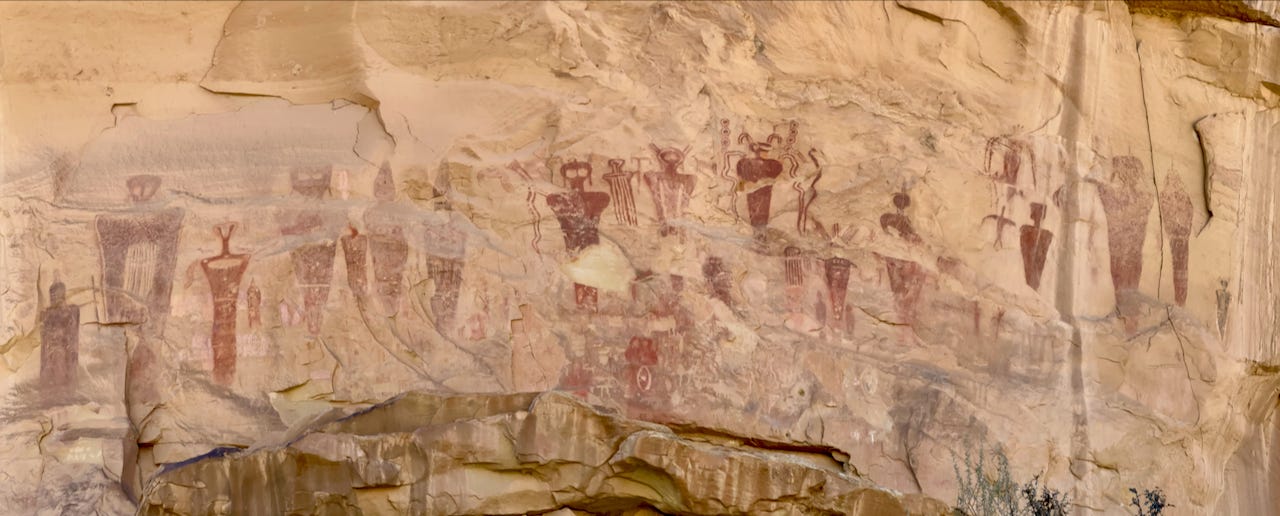
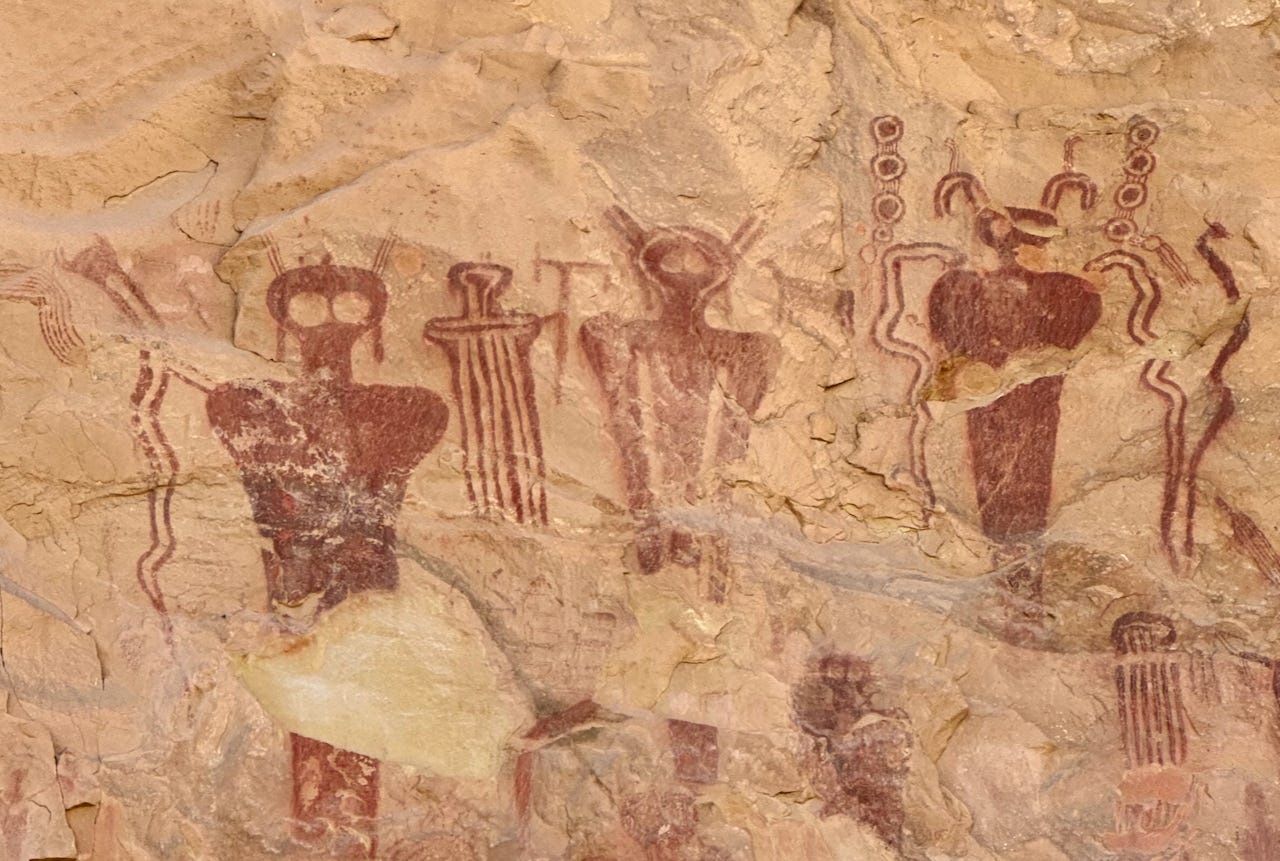
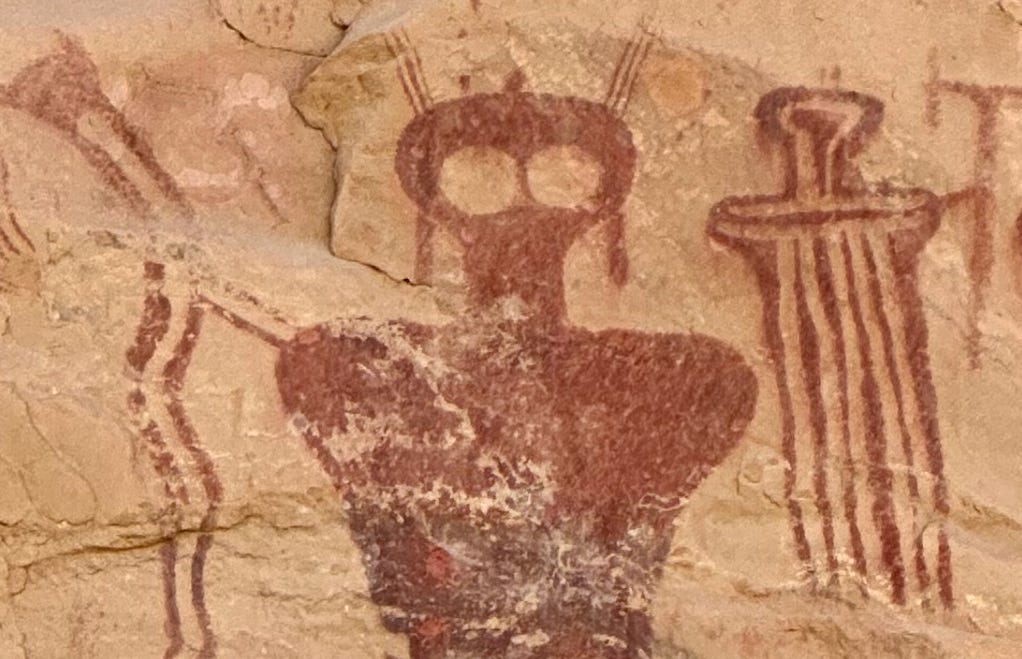
The figures have an unusual presence, even on a little smartphone screen. They appear as cloaked vibrating beings, bundles of psyche with hidden stories, ideas and beliefs. Every line is in motion, following a gesture across sandstone, fixed to the rock with animal or plant-based binders and pigment.
Between three and seven feet tall, they hold their presence above us as figures on a cathedral wall, curved into the rock face, sheltered by a slight eave that has kept the paintings from rain, wind and sun.
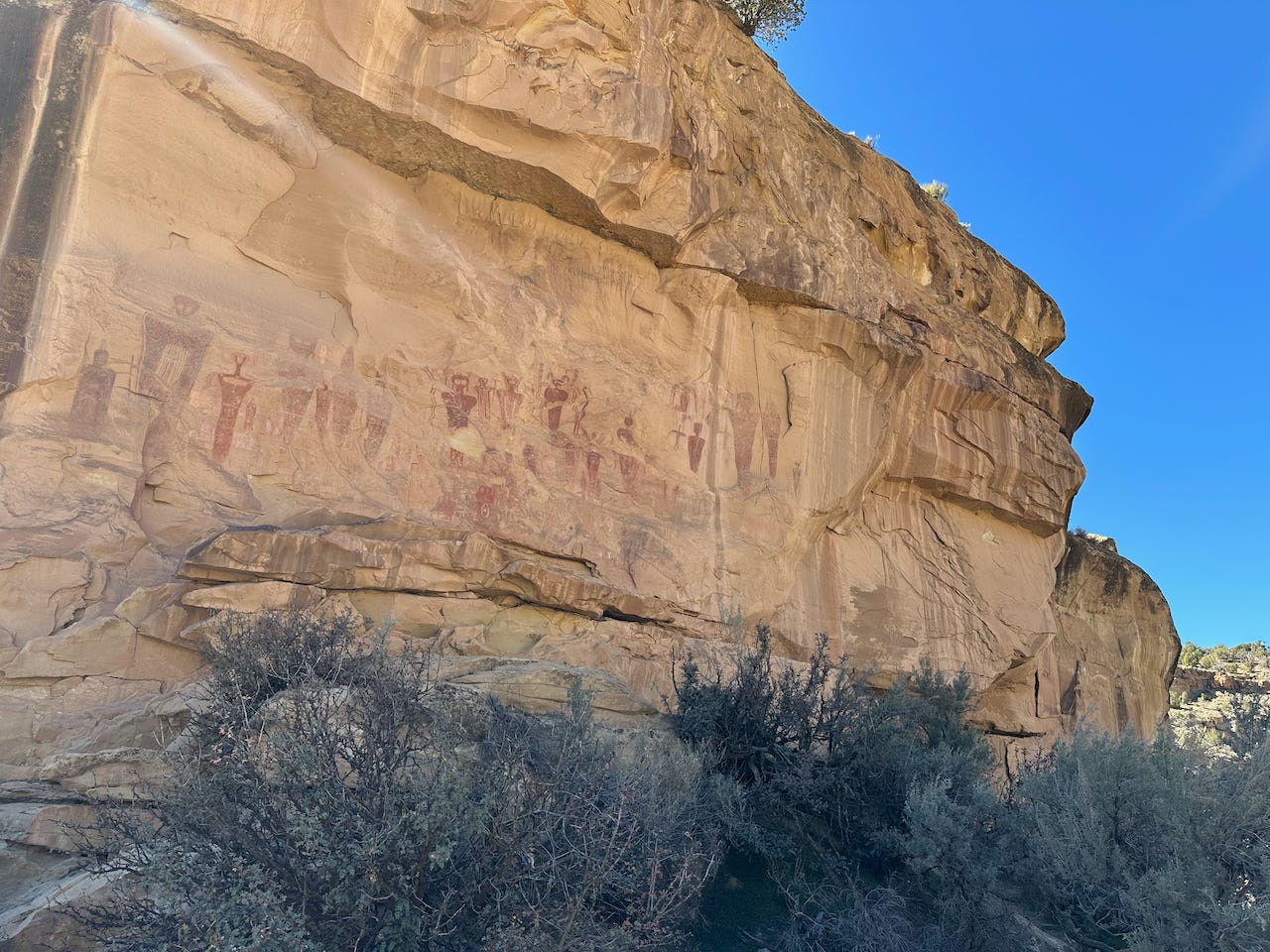
This space is sacred because it is full of mind. A work that speaks of a long human journey co-creating with non-human intelligences. Not only the painted animals, or spirits of animals, those other intelligences that engaged with these humans and taught them, but the marks of an intelligence in the materials themselves. The rock, ground minerals and organic matter hold a knowledge inscribed by natural forces.
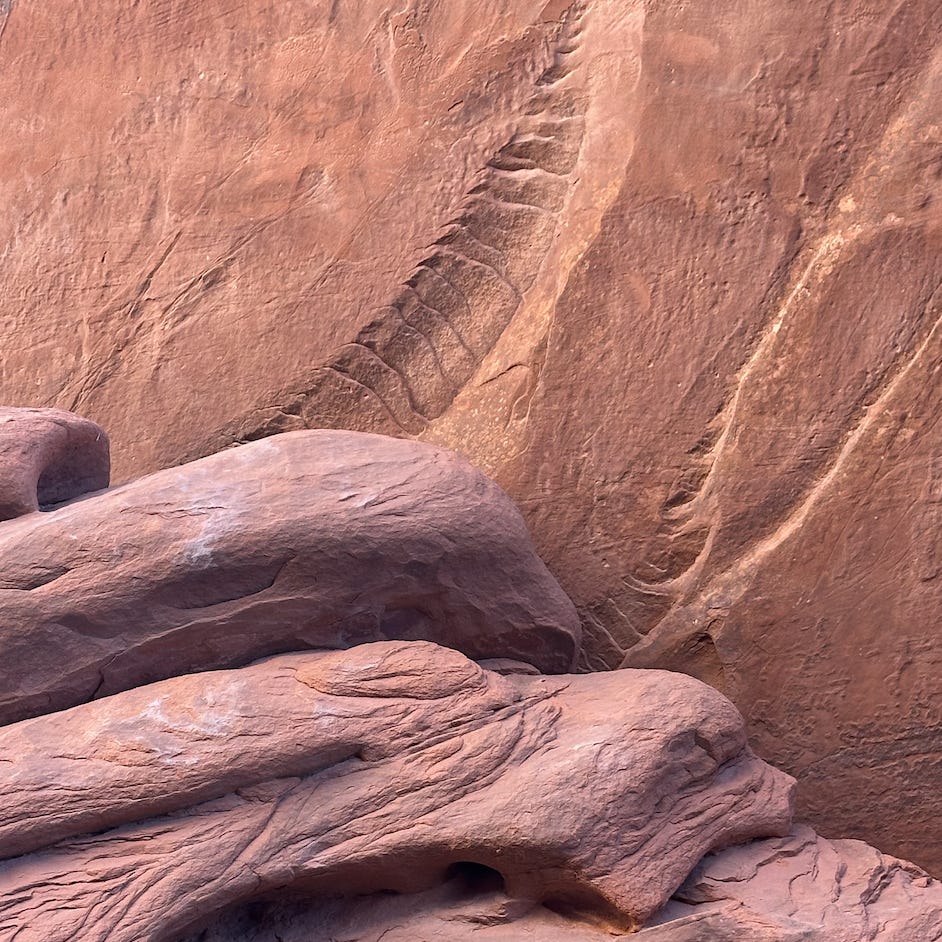
Nature's own markings seed the human imagination and the material forms human imaginings take. Some scholars suggest many of the BCS figures are rain gods; the patterns of vertical lines read as falling water, so desperately needed. And yet the Utah desert rock, in its sinuous etchings, tells the epic story of water.
The artists who painted here worked their materials, finding the right mixture for a paste. Someone reached up, or climbed, and made marks on the rock that became figures taller than the painter. Such care is evident in line and shape. There are patterns, and great variations within those patterns. No two figures are the same. Each feels like a discrete unit, a fragment in spatial constellation with other fragments, brought together in the act of perception. The technical process, location and material served a vision, and the vision called forth a technical process.
The evolution of craft and method, tools and materials, patterns and calculation, machines and intelligence systems: all of these address specific dimensions within evolving artistic practices. The technical and the material becomes ground for the visionary, oneiric and imaginal.
Blake’s Double Vision
Imagine William Blake bent over a copper plate, writing backwards the text and drawing in reverse the image for printing, and then hand-coloring the rendered visions from his dream life. Does he re-experience the dream visions during the printing process? Do these prints feed back into his dreams? Are they artifacts he made by his hands alone or did he deliver them from an elsewhere? Blake’s prints, combining word and image, are the only interface we have to access the world of his private imaginings. The prints also act as an interface to our own imagination when we read them. The tension between words, and words and image, resolves or clashes secretly in the mind.
“For double the vision my Eyes do see,
And a double vision is always with me.”“May God us keep
From Single vision & Newton’s sleep!”— William Blake, from letter to Thomas Butts, November 22, 1802
Blake resisted the uniformity of conventional machine printing, which imposed an efficient structure on the page: text as standardized block, fixed in typographic lines, distinct from image. He invented his own process to reintegrate handwritten text into the image itself, dissolving the boundary between word and picture. The technique, he claimed, came to him in a dream, revealed by the ghost of his dead brother. He called it "illuminated printing," a name that deliberately echoed the expressive manuscript traditions of the Middle Ages.
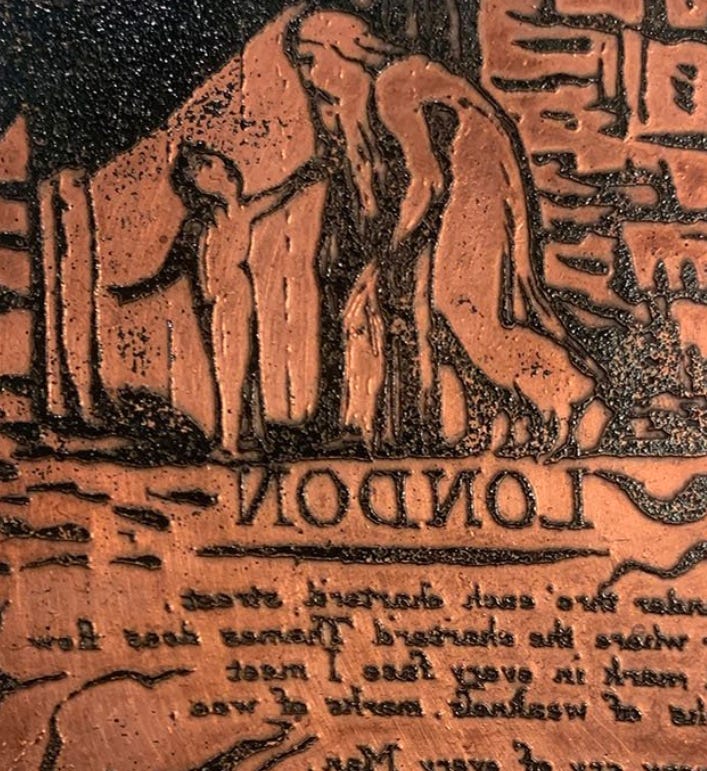
The process allowed him to sell unique works by adapting standard materials and techniques for a print market and at the same time stay truer to his poetic vision: awakening the reader’s mind and inner vision to dimensions not so easily accessed.
Discrete Data
With the arrival of intelligent machines that work with human creativity, beginning with cinema in the early twentieth century, the imagination as a “cognitive organ” enters circulation with artificial systems.
Ada Lovelace, whose famous father Lord Byron was a visionary poet of the Romantic Era following Blake, saw that Babbage’s Analytical Engine could do something beyond its designed function of calculation. It could manipulate symbols, not just numbers. It might be able to compose music. She was imagining what the future computer, starting from basic operations on discrete signals, could become with human design, seeing into its poetic potential before the material technology existed to manifest it.
The silent era filmmaker Jean Epstein had the insight that the discrete, discontinuous frames of the camera and projection system could not only produce moving images in the mind, but new expansive worlds for the imagination to move in. New realms of thinking formed around the intervals of frames and shots. The discontinuous nature of film gave cinema artists powers of slowing down, speeding up and reversing time. Later in his life he wrote The Intelligence of a Machine, describing cinema as a thinking machine, not just a recording device.
If I take a walk with my smartphone, and happen to capture on video an encounter that resonates for me, like a leaf spinning in place at the end of an invisible strand of a spider web, my creative role in that moment is only in the noticing. Composing the frame and pressing the record button is an act of conscious attention and intention. Everything else is handled by the smartphone. The image itself is an encounter between human and non-human forces: wind, falling leaf, spider, camera and my attention. To me this is the essence of cinema as an art: the human takes part in a convergence of embodied minds, natural forces and mechanical processes.
As embodied beings, we do not encounter the world in its fullness. We sample it. Digital images are selected through attention, framed by the camera, filtered through code. A culture is a shared accumulation of individual samplings, made by individuals, but preserved and remembered collectively with a sense of meaning that exceeds the fragments themselves. They have both a material existence (code, in the case of digital media) and am immaterial one.
Machines long ago entered how and where to put attention and what we remember or imagine or think. Language was the first technology for rendering imaginary beings and stories into collective memory. AI enters into this circulation with synthetic thinking and imagining.
The Imaginal
There is a concept from the 20th century scholar of Islamic mysticism, Henri Corbin, that is (paradoxically) close to the uncanny creative spaces I find myself in when working with machines. Corbin called it the Mundus Imaginalis (see his essay Mundus Imaginalis of the Imaginary and the Imaginal in Swedenborg and Esoteric Islam). The imaginal realm is a real territory between mental and physical form, where intelligent entities live as latent abstractions, before they become experienced in an individual mind’s visions, dreams and transformed into poems, paintings or films.
If such a realm exists, we do not enter it whole. We approach it through the same filters that shape all experience: body, language, culture and technology. And yet something in it resists those filters. The imaginal arrives with a density that feels discovered rather than made. I am taking liberty with the spiritual nature of what Corbin himself called “active imagination”, but I believe artists have always worked at this threshold, not fully in control, and not entirely passive.
Corbin used the term to translate a concept from Islamic thought: ʿālam al-mithāl, the world of images or world of analogies. He chose “imaginal” deliberately, to avoid the Western assumption that imaginary means unreal. The imaginal, in Corbin’s view, is not inside the psyche. It is not a projection of the mind onto the world. It is encountered rather than invented.
The imaginal can arrive as dream, but not all dreams are imaginal. It can be invited through intentional practices: meditation, art, poetry, dance, fasting, psychoactive substances, darkness retreats. It can arrive spontaneously. The imaginal is experienced as an “other” dimension, with its own coherence, depth, and density. It is a space where images are not just representations or symbols to be decoded, but vivid experienced events or revelations.
Corbin’s Mundus Imaginalis is a challenge to contemporary materialist logic. It proposes mind, a generator of images, as not limited to the human brain. I recommend entertaining this idea at least as an exercise. Why? The stakes are high as life now merges with human-designed intelligent machines that can synthesize any text, image or sound. If the imaginal were just the shared but personal unconscious expressions of individual souls, then a machine generating its outputs is just more pattern-matching on the same cultural archetypes stored inside individual memories. AI slop hints at the fear of such self replication, of AI sampling AI in an infinite loop, leaving behind the the human source inside ever-shrinking private lives.
But if Corbin's imaginal is a real intermediate realm, where the individual can encounter other dimensions of non-human intelligence through interior images, then generative AI technologies, like all media technologies, are participating in something ontological, something that exists independently of any mind that encounters it. AI is not mind. It participates in mind through the human.
An Intelligent Mirror
With generative AI, I start with an intention, with specific words for what I want as a result, as if I know best. But the image or text returned often resists the subtleties of that intention, sometimes displacing the idea entirely. This can be a frustration if using AI as a tool. Treated as a medium or collaborator, what comes back becomes the ground for the next prompt, as in the surrealist game of exquisite corpse. Something in the model’s pattern-matching has opened a possibility I hadn’t seen, and I follow it. A back-and-forth ensues. The destination becomes unclear.
Where am I? Am I losing my creative soul? Or am I activating it by altering my own limited training? What has been lost or gained in this hybrid process of creating?
The film camera, the computer and the large language model work something like the human mind. They are precision systems that sample and disassemble waves and ripples emanating from the world into discrete data, signals, then reassemble those units into a mirror reflection of something felt, thought, imagined and remembered. The brain does does not receive the world whole, but constructs a version of it from fragments stitched into apparent continuity. Discrete data return as waves of affect and ripples of thought in an act of transmission. Machines only fulfill their creative or cognitive role where there is an embodied human experiencing, guiding and operating the process.
This way of thinking is all very risky, seeming paradoxical. Maybe even offensive in these contentious times. And yet all through history it is the mechanical and technical, the tools and methods, the units and measurements, that has changed how and what humans imagine. The danger that Blake warned about is handing over interior images, the soul, to flat single-vision of machine logic.
A large language model knows nothing, has no body and no magic of embodied awareness. It awaits a call before a response. But can it function as a mirror and circulate the imaginal back through the human? Isn’t this what cinema does, and all our multimodal devices (for better or worse)? Isn’t this what a book does? Painted figures on sandstone? These are coded surfaces or mirrors where something becomes present to the mind, and enters circulation through the imaginal.
The imaginal is never pure. It is mediated by a material substrate, language, ritual, belief system, and the technologies available for externalizing what is interior. The illuminated manuscript, the cathedral window, the fresco, the novel, the movie, the Netflix show, each provides a particular reflection of mind.
We must take care of these reflections.
AI is not replacing the imaginal. It is operating within it, altering how images form, how they circulate, how they move in conversation between humans and their machines. We make ourselves alongside our tools. AI simply makes that co-creation impossible to ignore. Sometimes a generated image feels closer to my intention than my own first attempt. The boundary between human and machine grows increasingly porous.
My best defense against single-vision is to explore imaginatively, attend to the details, take care with the visions, and maintain a presence of mind.